


KEY TAKEAWAYS
HVAC and plumbing distributors simultaneously manage market pricing, customer-specific pricing, and project-specific pricing. Margin leaks when sales teams confuse these models or generalize one price to another. Separating them cleanly, unifying pricing data, and enforcing the right rules at the point of sale stops leakage and protects commitments.
Every HVAC and plumbing distributor runs three pricing models at once: market, customer-specific, and project-specific.
Confusing customer or project prices with everyday market pricing is a primary source of margin leakage.
Customer-specific pricing fails through either over-discounting (leakage) or failing to honor contracted prices at a branch (friction).
Project pricing needs guardrails—owner, scope, SKUs, quantity envelope, and expiration—so deep discounts do not spill into restocks.
Unified pricing data plus AI can surface leakage, enforce guardrails, optimize price bands, and manage negotiated-price lifecycles.
Every HVAC and plumbing distributor runs three distinct pricing models at once: market pricing, customer-specific pricing, project-specific pricing. Often distributor sales teams confuse these; taking a customer specific or project price and generalizing it to all their customers – this is where margin leaks away. Separating them cleanly, unifying the data behind them, and creating visibility to the sales teams solves the problem.
Walk the counter or sales office at any HVAC or plumbing distributor and the same negotiation plays out a dozen times a day. A contractor calls for fittings, a compressor, a water heater. Somewhere between the parts list and the invoice, a customer objection, a number gets chosen — and often it's the wrong one. Multiplied across thousands of transactions a week, that difference is the gap between a healthy distributor and one quietly bleeding margin.
What Is Market Pricing?
Market pricing is going rate pricing for a similarly segmented contractor, commercial or industrial customer. It is a fair price accepted widely in the market by these customers for discretionary purchases.
Product margin varies enormously across product and customer segments. Commodities can carry thin margins; too deeply discounting, here, trains customers to expect even deeper pricing when projects come along. Proprietary parts, controls, and accessories often carry far richer margins and less price transparency. Sales managers who know where the margin lives can hold firm on commodities, flex on the right high-margin items, and be competitive without gutting profit.
What Is Customer-Specific Pricing?
Customer-specific pricing is a negotiated pricing tied to a particular account, earned through volume, loyalty, or payment terms, and expected on every order, at every branch, every time. Customer specific pricing stands in front of market pricing and delivers targeted pricing sometimes supported by OEMs.
Distributors lose in two directions here. Leakage: a rep, wanting to take care of a good customer, discounts too deeply from the customer’s market price — giving away margin for goodwill and creating the expectation there is always a deeper price…..when there isn’t one. Friction: the reverse is worse. A customer who negotiated contract pricing hits a branch that quotes a lesser discount. They know what they're owed, and nothing damages a hard-won account faster than making them fight for the price you already promised. The temptation is to either clamp down (and lose deals) or open the floodgates (and let discounting run wild). The answer is bounded process discretion. And the essential question isn't “how much can I discount?” — it's “which products can I discount, and why?”
Both Leakage and Friction trace to the same cause: customer pricing isn't cleanly defined, centrally maintained, and enforced at the point of sale.
A rep flying blind discounts the wrong things and destroys margin while thinking they’re competitive.
What Is Project-Specific Pricing?
Project-specific pricing is a deeply discounted quote tied to a single job — valid for that scope, quantity, and timeframe only. The economics work because the scope is defined and is almost always OEM supported.
It looks like customer pricing but behaves completely differently, and the failures are specific. The project price leaks into everyday orders when a rep quotes the job number out of habit, applying a 4,000-unit discount to a 12-unit restock. It expires but never gets closed, bleeding margin on every transaction that references it. Or the rep can't honor it when it's real — because the deal lived in an email or someone's head — and the distributor looks disorganized on the one deal where reliability mattered most.
Project pricing demands guardrails: an owner, a scope, a SKU set, a quantity envelope, and an expiration date.
Market Pricing vs. Customer vs. Project vs. : A Quick Comparison
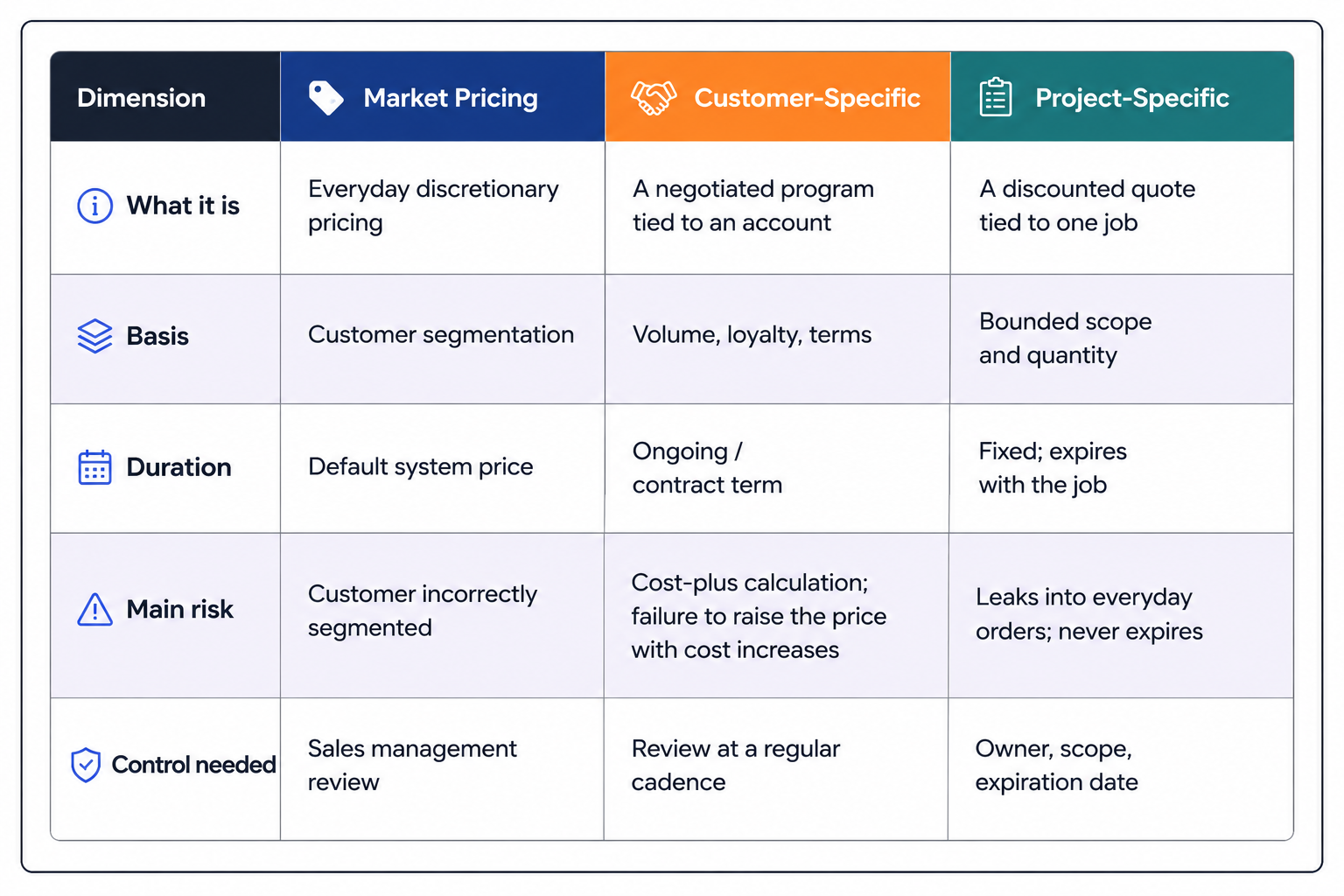
Why the Pricing Data Is the Real Asset
Each model fails not because the strategy is wrong, but because the data underneath is stale, siloed, or invisible at the moment of decision. Contract terms sales can't see. Project deals in email. Margin knowledge locked in one branch manager's head.
That pricing data is one of the most under-exploited assets on the balance sheet. It encodes what every customer is worth, what every deal actually cost, and where every dollar of margin comes from. The strategic goal is balance: honor customer pricing automatically so no discount stacks on an earned price; fence project pricing tightly so it expires when it should; guide market pricing with customer, product-level intelligence so reps know what can flex and what stays firm. Get that balance right and the same team, selling the same catalog, produces materially more margin — just by stopping the leaks and keeping the commitments.
How to Optimize Distributor Pricing with Unified Data and AI
Once the three models are unified, the data becomes usable in ways silos never allowed:
- Margin leakage analytics surface inappropriate discounts and expired project pricing that are quietly eroding profit.
- Guardrail engines put the right discount envelope in front of the rep at the moment of quote — informed by product margin, customer segment, and competitive context.
- Price-band optimization tunes margins by product family, region, and customer segment.
- Lifecycle management gives every negotiated price an owner, a scope, and an expiration the system enforces automatically.
This is precisely what AAXIS delivers for distribution enterprises — unifying fragmented pricing, product, and customer data across commerce, CPQ, CRM, and PIM systems, then applying AI to turn that data into decisions at the moment they matter.
The Bottom Line
Every HVAC and plumbing distributor already runs three pricing models. The only question is whether they run them deliberately. Customer pricing is a promise to keep. Project pricing is a bet with an expiration date. Market pricing is judgment that needs data to be good judgment. Define them cleanly, maintain them centrally, and enforce them at the point of sale — and the pricing data you already generate stops being a liability and becomes the engine of your margin strategy.
The distributors who win the next decade won't have the lowest prices. They'll be the ones who know, precisely and in real time, which price to offer, to whom, and why.
See how AAXIS unified pricing, product and customer data to stop margin leakage – book a consultation!.
Frequently Asked Questions
What are the three types of distributor pricing?
The three types are market pricing (everyday discretionary pricing used to stay competitive), customer-specific pricing (a negotiated program tied to an account), and project-specific pricing (a discounted quote tied to a single bounded job).
What is the difference between customer-specific and project-specific pricing?
Customer-specific pricing is an ongoing commitment tied to an account and applies to all their orders. Project-specific pricing is temporary, tied to one job's scope and quantity, and should expire when the job ends. Confusing the two causes deep project discounts to leak into everyday orders.
How do distributors prevent margin leakage from pricing?
By unifying pricing data across commerce, CPQ, CRM, and PIM systems, enforcing contract prices automatically, giving project prices an owner and expiration date, and guiding market discounts with product-level margin guardrails so reps discount the right SKUs.
Why is pricing especially challenging for HVAC and plumbing distributors?
These distributors handle thousands of SKUs with widely varying margins — thin on commodities, richer on proprietary parts and controls — across many branches and both contract and walk-in customers. Without unified data, the right price is easy to miss at the counter.